


Educational Mechanics
Quick Release Valve – How It Works in Air Brake Systems
Jump to:
1. What the Air Brake Quick Release Valve Does
2. How It Works – Step by Step
3. Key Components Involved
4. Common Misconceptions
5. Why This Matters

A quick release valve is used in air braking systems to reduce brake lag by allowing air to exhaust closer to the brake actuators rather than travelling back through the control valves. This improves how quickly the brakes release and how rapidly spring-applied brakes can be applied.
In an air braking system, air enters components quickly under pressure, but it takes longer to escape as pressure decreases. Without a quick release valve, air must travel back through the control valves to exhaust, which can delay brake release or park brake application.
By exhausting air locally near the brake actuators, the quick release valve reduces this delay.
How it Works - Step by Step
-
Brake application
When the driver applies the brakes, compressed air flows from the control valve through the quick release valve to the brake chambers. During application, the valve behaves like a normal air passage. -
Valve sealing and hold
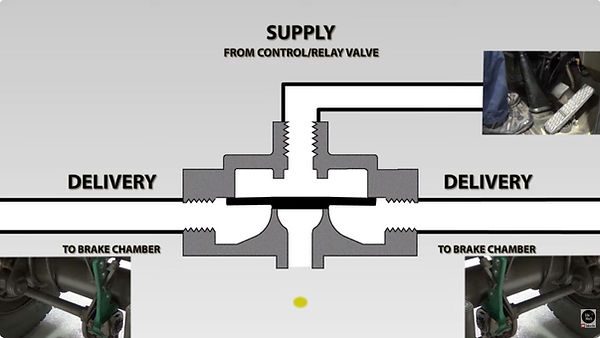
As pressure builds in the brake chambers, air pressure acts on both sides of the internal diaphragm. With equal pressure above and below, the valve closes both the inlet and exhaust ports, holding the applied brake pressure. -
Brake release
When the driver releases the brake pedal or applies the park brake, pressure above the diaphragm is reduced. Higher pressure below the diaphragm lifts it, opening the exhaust port. -
Local exhaust
Air from the brake chambers exhausts directly through the quick release valve rather than travelling back to the control valve. -
Rapid response
Because the exhaust path is shorter, the brakes release or apply more quickly, reducing brake lag.
Throughout operation, the valve rapidly switches between three states: on, hold, and off.


Key Components Involved
-
Quick release valve
The valve that allows rapid exhaust of air near the brake actuators. -
Supply port
Receives air from the control or relay valve. -
Delivery port(s)
Sends air to the brake chambers; multiple delivery ports may be used when mounted on an axle. -
Exhaust port
Vents air to atmosphere during brake release. -
Diaphragm
Responds to pressure differences to open or close the inlet and exhaust paths.
Common Misconceptions
-
Quick release valves do not increase braking force
They improve response time, not braking power. -
They do not replace control valves
The foot and hand control valves still determine when braking occurs. -
They are not only for service brakes
Quick release valves can also be used in secondary and parking brake circuits.
Why This Matters
Quick Reference
Understanding the function of the quick release valve explains why air brake systems can respond quickly despite using compressed air. It also clarifies how brake lag is managed in both service and secondary braking circuits.
This knowledge provides a foundation for understanding other air brake components and how they work together as a system.
-
System: Braking systems
-
Component: Quick Release Valve
-
Primary Function: Reduce Brake Lag
-
Operating States: On, Hold, Off